Monday, June 27, 2011

FEMALE CIRCUMCISION - A HUMAN RIGHTS VIOLATION OR RITE OF PASSAGE? PART II

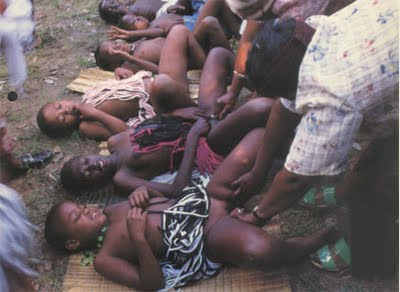
This Ethiopian little girl does not have a choice or a voice.
Opponents of female circumcision emphasize that the practice is detrimental to women's health and well-being. Some consider the practice a ritualized form of child abuse and violence against women, a violation of human rights.


Female circumcision, aka female genital mutilation/cutting (FGM/C), is a relatively recent debate. The practice was hardly spoken of in Africa and little was known in the West until the 1950s and 1960s. At this time activists and medical practitioners tabled the health consequences of female circumcision to the World Health Organization (WHO) and United Nations. It was not until 1979 that any formal statement was made urging governments to eliminate the practice in their respective countries. The following decade, the widespread silence surrounding female circumcision was broken.


The WHO categories female circumcision into four major types:
Type I -      defined as partial or total removal of the clitoris (clitoridectomy) and/or the prepuce (clitorial hood.
Type II -     defined as partial or total removal of the clitoris and the labia minora, with or without excision of the labia majora.
Type III: Infibulation with excision - defined as narrowing of the vaginal orifice with creation of a covering seal by cutting and repositioning the labia minora and/or the labia majora, with or without excision of the clitoris (infibulation).
Type IV: Other types - defined as all other harmful procedures to the female genitalia for non-medical purposes, e.g., pricking, piercing, incising, scraping and cauterization. 


Female circumcision is an integral part of patriarchal societies where the male authority and control of female sexuality and fertility are givens.


Efforts to eliminate female circumcision have often been unsuccessful because opponents of the practices ignored to mention its social and economic context. They were out to bash the practice without seeking practical solutions. Many African women have perceived many of these efforts as condescending and derogatory toward their culture. It is offensive to those who believe in the practice to be "ordered" to stop it. They do not mind the good advise but they recent the tone and condescending arrogance of the West.


The strong reactions against depictions of cultures practicing female circumcision as savage, violent and abusive of women and children have led to new ways of approaching the issue. Some amiable approaches include community education, reaching out to community health workers and educating them on the harmful effects of female circumcision. Another approach used in Kenya by the Maendeleo Ya Wanawake organization, was working with communities to come up with alternative rites of passage (rituals). In Burkina Faso the director of a local theatre produced a play, based on the experience of his niece, on the consequences of female circumcision. The play was aimed particularly at men.


Most of the countries where female circumcision occurs have signed international treaties that condemn gender-based violence. Many have laws against female circumcision. Given the lack of enforcement of most laws against this practice, it unclear whether a purely legal approach is effective in itself.


Significant change is likely to take place only with improvements in the status of women in society.

Saturday, June 25, 2011

FEMALE CIRCUMCISION - A HUMAN RIGHTS VIOLATION OR RITE OF PASSAGE? PART I

Traumatic experience

This is a painful topic to dwell on because of the horrific nature of the practice. Female circumcision (FC) is also referred to as female genital mutilation (FGM) in the West or now the politically correct term often used internationally is female genital cutting (FGC). None of these terms make the topic easier to discuss.
I have always preferred the term female circumcision because that is what I grew up knowing and it did not have a negative connotation or stigma attached to it. I understood the practice as a rite of passage for various ethnic groups including my own. I have members of my family who went through this "rite of passage" and it gave them status and a sense of authority within the community. 

So when I began attending international conferences or forums where the practice was labeled as female genital mutilation I was offended and appalled at the level of Western condescending ignorance and arrogance. I believed then and now that there is a better way to approach this debate than with the condemnation and rage it is often presented in.
Girls this young face this ordeal for the sake of family, culture or religion
As I researched and read biographies of girls like me who had undergone the "knife" the reality of the practice set in. Not all ceremonies were celebrations and for some girls circumcision came as early as less than two months old, like in Eritria; or six years like in Mali and almost 10 years in Egypt. The operation is generally carried out by a traditional birth attendant or an exciseuse, who is usually an elder village woman. These village women have little or no knowledge of human anatomy or medicine. Female circumcision can cause death or permanent health problems including severe pain.

Waris Dirie
Waris Dirie, a Somali woman who moved to London at the age of 14 years has written an account of her horrific experience at a young age. In her book she describes the constant pain whenever she urinated, and that the circumcision made urination a very slow process. She was in excruciating pain whenever she had her period because her body was unable to excrete the blood as fast as it needed.  She describes how she and her sisters used to dig a hole in the ground and bury themselves in it to help cope with their period pain.  Read some extracts of Waris Dirie's autobiography and circumcision experience here.

Ugandan girl being circumcised
Despite all these risks and others the practice is still an integral part of many cultures and their ethnic identity and for some a religious obligation.

There are various reasons given for FC. In many communities they probably do not even know or question the reason for the practice. In other communities it is the social pressure to conform and not be labeled as a social misfit. Social pressure is a great motivator because it many cases it determines if your daughter is qualified to be married as well as determining the bride price. Circumcision is also the tool used to ensure premarital virginity and marital fidelity. This is a necessary part of raising a girl properly, and a way to prepare her for adulthood and marriage.

Next - forms of FC/FGM/C and consequences... Part II

Friday, June 24, 2011

WOMEN OF AFRICAN DESCENT ARE UNATTRACTIVE

Satoshi Kanazawa
Dr. Satoshi Kanazawa caused an uproar last month when he published what he claimed to be a "scientific study" proving that women of African descent are less attractive than other women. The blog article in Psychology Today, May 15, 2011, was immediately removed with no explanation or apology from its editor-in-chief, Kaja Perina. Ms. Perina issued a statement one week later apologizing and taking responsibility for having the article on their magazine. The magazine later expanded on their apology saying that they would take steps to prevent similar content in the future and dismiss Kanazawa from his position. Though the post was removed from the site you can read it here.

Satoshi, an Evolutionary Biologist and professor at the London School of Economics, is well known for his controversial and offensive pseudoscientific shock-jockery. He, however, continues to teach at a respected university, was posting on the blog of a reputable mainstream publication and still serves on the editorial board of the Journal of Social, Evolutionary and Cultural Psychology.

Dr. Kanazawa's arrogance and overt bigotry was nurtured by these institutions that continued to give him a platform. This latest post pushed too far and there was a concerted outcry around the world expressed via the social networks and other media. Psychology Today removed the post late Sunday night and by Monday morning, May 16, 2011, the University of London Union Senate, the largest student organization in London (representing 120,000 students), unanimously called for Kanazawa's dismissal. The reasons stated for this call for dismissal include flawed research and unscientific bigotry.

I can give my own research-based reasons as to why this "study" is clearly not objective but I choose to counter Satoshi's bigoted theory with the following physically "subjective" photos of attractive women of African descent.


Attractiveness is subjective not objective!

Thursday, June 23, 2011

SOMALI WOMEN: CHANGING CULTURAL DYNAMICS

Somali women in the US
Somali women in the US have worked hard to break the stereotypes and cultural norms by working to support their families.  For many of these women, owning their own businesses gives them the financial independence they did not have in their home country. In Somalia, men are the breadwinners particularly in the Muslim households, while the women keep house and take care of the children.

The roles change once these families come to the United States and the women set up shop bringing home paychecks.

Many of these families have migrated to the US to escape the civil war in Somalia. The American Community Survey estimated a little over 100,000 Somalis lived in the US in 2009. Almost 30,000 living in Minnesota, although other sources suggest as high as 60,000.

According to the US Census Bureau, the median household income for Somalis is among the lowest, with 51 percent living in poverty. The efforts of Somali women within their communities is changing this statistic. They are not only changing the cultural dynamics of the Somali home but they are also contributing to the community at large, highlighting the importance of the role of women in society.

Male reaction/response to these changes are varied. Some have accepted and are assisting the women in their business enterprises. Others have been unable to adapt bringing on the foreign concept of separation and divorce.

Wednesday, June 22, 2011

SOMALI WOMEN AND POLITICS - TOTAL REVOLUTION!

Asha Hagi Elmi
Asha is one of those unique women who decided that she could not wait for the rest of the world to come help stabilize her country of Somalia.

Somalia has suffered through years of conflict between clans, lawlessness, failed peace talks and a current transitional government fighting for control.  However, through it all, Asha Elmi maintains that Somalis must take responsibility and the first steps to invest in their future.  

Her mission is restoring order and creating a stable government in Somalia.  She is a member of Somalia's transitional parliament and heads the first and only clan made up of women. It is considered the sixth clan since there are five major clans in Somalia.

The uniqueness of her clan is that the women are from the different Somali clans that fight for dominance. It crossed the clan lines. Asha understood the effects of conflict between clans because like many Somalis she married outside her clan. Neither her birth or married clan accepted her. She says she realized that the only full identity she had, was her womanhood identity. The road to peace has been long and dangerous of this mother of four.

Voiceless women need to be heard
In 1992 Asha Hagi and her husband founded Save Somali Women and Children (SSWC) while living in Nairobi, Kenya. The purpose of the organization was to advocate for equal rights for women in politics. This was and continues to be a difficult endeavor considering Somalia is a muslim country and in particular women are considered second class citizens.

In 2000 the Sixth Clan secured 25 assembly seats (10% of the Transitional National Government). For the first time in Somali history women officially had a voice. Asha Hagi called it a "total revolution". 

After several more peace talks and a reconciliation retreat, Asha made history by being the first woman to sign a peace accord in Somali on January 29, 2004. The women also made another significant gain as their role in government increased to 12 percent of parliament's seats.

In 2005, Asha's name was included in the list of "1000 Women for the Nobel Peace Prize". Unfortunately her name also topped the warlords' hit list. She has refused to let this terrifying designation deter her. She continues to fight for a restored and stable Somalia.


Tuesday, June 21, 2011

SOMALI WOMEN


Women in Somalia are coping with very serious trauma each day of their lives. The Somali society has been deeply affected by decades of war.  This is evidenced frequently in the emotional nature of their discussions concerning their country.

However, this has not incapacitated the women who are very much involved in the humanitarian sphere. The Somali Women's Agenda (SWA) represents nearly 200,000 women in Somalia and the diaspora. A core group meets regularly, traveling from the USA, Canada and Europe to join members living in East Africa. They tread carefully around political issues in Somalia to protect members still living in the country. Although the group does not engage with Shabaab (a terrorist group) or other extremists, the women find themselves with unique advantages of being able to reach perpetrators of violence and ideologues through their influential roles as mothers and wives.


The aim of SWA is to promote the role of women in politics and peace processes. A few of their members have managed to secure elected positions in the local and federal government. The group strongly advocated for women to be represented in the commission reviewing Somalia's new draft constitution and succeed in getting seven women on the 30-male dominated commission. Two of the women were members of SWA.

It has had to take women standing up in conflict areas to demand a seat on the peace-commissions, draft-constitution commissions and even peace discussion, in order to get things done.  In Liberia the women forced the men to finalize and complete a peace treaty negotiation by locking them in the meeting room. They then spearheaded the election of the first woman president in Liberia.

We see the same demands for a voice from women in Egypt, Libya and Tunisia. Somalia is no exception even though there is no immediate sight of peace or stability in that country. The women are rallying together to have a voice in the political forums and assemblies.


Monday, June 20, 2011

Stoning of Iranian Women


Soraya Manutchehri, 35, was stoned to death for being an "inconvenient wife".  She refused to grant her husband a divorce even though he made it clear he did not love her or want her. He desperately wanted to marry the 14 year-old daughter of a jailed doctor. She also rejected the Mullah's offer to be his lover in exchange for protection and monetary support for herself and her two daughters. Soraya was stoned on   August 15, 1986. 

The Stoning of Soraya M. is a 2008 American film adapted from French-Iranian journalist Freidoune Sahebjam's 1990 book La Femme Lapidée. The film is based on the true story as narrated by Zahra, Soraya's Aunt.

Sakineh Mohammadi Ashtiani
Recently, Sakineh Ashtiani, a 42 year-old former kindergarten teacher, gained international attention for a conviction of adultery and accompanying sentence of death by stoning.

This Iranian woman has been imprisoned since 2006 and is under a death sentence. An international campaign to overturn her sentence was started by her children through letter published by Mission Free Iran. Their continued campaign fueled world wide protests on July 2010 in Rome, London and Washington D.C. Calls to stop her execution came from leading human rights group and high-profile celebrities and heads of state.

On July 31, 2010, Brazil's president, Luiz Inácio Lula da Silva, proposed to Iranian president, Mahmoud Ahmadinejad, to send Mrs. Ashtiani to Brazil where she would be granted asylum. This proposal was summarily dismissed with the suggestion that Lula had "not received enough information about the case". Hillary Clinton, on August 10, 2010, urged Iran to respect the fundamental freedoms of its citizens referring to Sakineh Ashetiani's case.

Iranian authorities recently, January 2011, said it is possible that the original sentence to be stoned could be dropped but offered no comment on whether she could be hanged. Her life hangs in the balance as she waits in an Iranian jail.

These are among the few stories that make it out into the mainstream media. There are many women who continue to suffer the fate of Soraya and Sakineh. A woman in the city of Arak who was stoned on August 10, 1994. According to the ruling of the mullah, her husband and two children were forced to attend the execution. In the city of Qom, a woman who was being stoned, on October 1989, managed to pull herself out of the hole, only to be forced back into it and stoned to death.

The stoning of women is one of the more untamed, uncivilized and revealed aspects of the mullah's rule in Iran. It is unfortunately carried out under the name of Islam.
These women need a voice. We need to speak out on their behalf.